
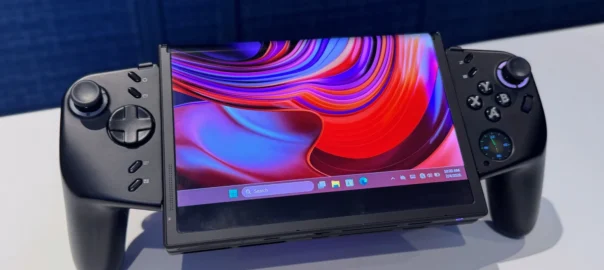
At Mobile World Congress 2026, Lenovo unveiled one of the most experimental gaming handheld concepts in recent memory. The Legion Go Fold is exactly what its name suggests—a Windows-based gaming device built around a foldable POLED display that transforms between multiple configurations. It represents Lenovo’s ambitious attempt to answer a fundamental question: what if a single device could be a handheld console, a tablet, and a laptop all at once?
Lenovo Legion Go Fold: The Shape-Shifting Handheld
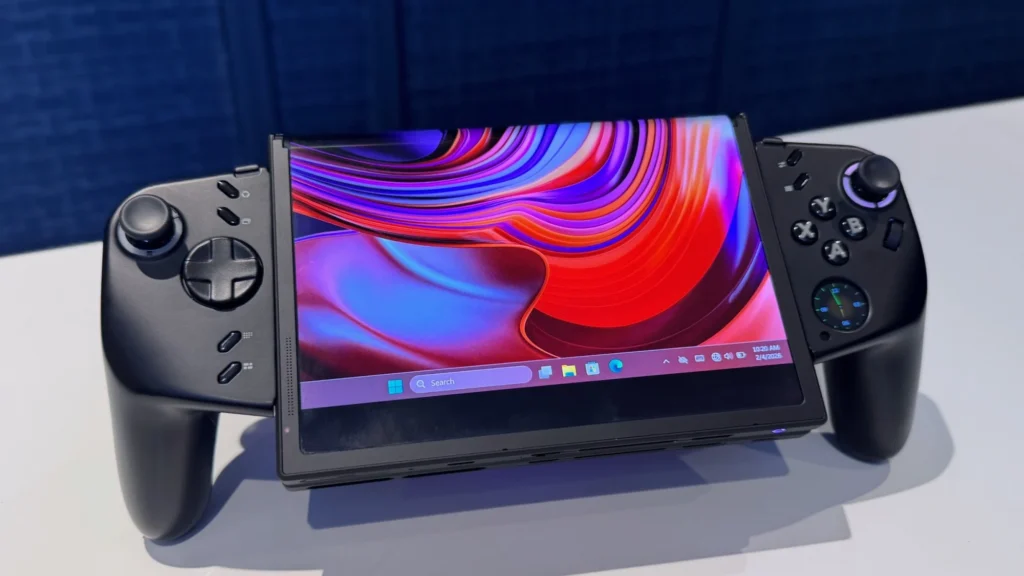

The Legion Go Fold party trick is its hinge. When folded, it presents a 7.7-inch screen that feels like a traditional handheld, with detachable controllers snapping onto either side. Unfold it, and the display expands to 11.6 inches of usable real estate, transforming into a mini-tablet perfect for media consumption or touch-based games. The controllers themselves can attach in either landscape or portrait orientation, theoretically accommodating both widescreen games and vertical content like mobile shooters or social media streams.
Lenovo envisions multiple usage modes. In Handheld Mode, the device functions as a conventional portable console. Full Screen Mode unfolds the display horizontally for expansive single-screen gaming. Split-Screen Mode positions the screen vertically, allowing gamers to play on one half while streaming a walkthrough on the other. Desktop Mode attaches a detachable keyboard, effectively turning the Legion Go Fold into a Surface-style Windows laptop for productivity tasks.
Under the hood, the concept prototype runs on an Intel Core Ultra 7 258V Lunar Lake processor, backed by 32GB of RAM and a 48Wh battery. These specifications suggest reasonable performance for integrated graphics gaming, though serious gamers would likely demand more power. The 165Hz refresh rate on the foldable panel indicates Lenovo takes the gaming credentials seriously.
Hands-on impressions from early testers reveal both promise and rough edges. Mashable’s editor described the foldable screen as “really frickin’ cool” and noted the device is “surprisingly light”. However, PCMag’s hands-on raised concerns about build quality—the controller attachment mechanism felt wobbly, and the trifold kickstand cover proved frustrating to deploy correctly. As a prototype, these issues may be resolved before any potential commercial release.
The bigger question is whether the Legion Go Fold solves a real problem. PCMag questioned whether it fills any need that an existing tablet or handheld couldn’t address better. Yet Lenovo’s pitch—targeting gamers who lack hours to sit before a TV or don’t want to juggle separate work and play devices while traveling—has merit. With a starting price likely exceeding the $1,099 Legion Go 2, the Fold would need to execute flawlessly to justify its premium.
Lenovo has a track record of bringing concepts to market, so the Legion Go Fold may eventually become reality. Whether it succeeds or not, the device demonstrates that the handheld gaming category remains fertile ground for radical experimentation.